By Ebuka Onyekwelu, Ph.D
Despite the introduction of an open and direct primary election system, where all party members participate to choose a candidate for an elective position, Nigeria’s party democracy tends to suffer from the same problem of manipulation. The indirect party primary system deliberately disenfranchised the majority of party members and denied them the right of participation in the candidate selection process. That system also led to various impositions of candidates by party leaders, creating a litany of propositions for internal party democracy, which ordinarily would have been addressed by the direct system now in place. However, the recent experience suggests otherwise. Indeed, the major challenge with Nigeria’s democracy rests with Nigerian political parties and how the parties are managed by their leadership, which speaks to a lack of consensus among the political class. That is why, whether it is the direct or indirect primaries, the results are the same. There is something fundamentally wrong with the concept of democracy within the context of Nigerian politics. Therefore, party democracy cannot be treated in isolation in terms of the relevance of the democratic system in realizing the aspirations of the Nigerian people. Simply put, a party-based democracy is as good as the political parties playing within that system.
With the recent outcome of the direct primary elections in the ruling All Progressives Congress (APC), where several reports reflect deep controversies about the outcome, it appears that party members themselves have conspired with politicians to defeat democracy in their own political parties. Worst still, there is still rancor among contenders, with the winner affirming the uprightness of the process, while the loser discredits the process. In Delta State, while the incumbent senator for Delta North, Senator Ned Nwoko, lost to the former Governor, Dr. Ifeanyi Okowa, the former claimed the results were rigged. But the latter insists it was the expressed will of the people. In Kaduna Central, Kaduna North, and Kaduna South senatorial districts, some aspirants, including a former State Assembly Speaker, Rt. Hon. Yusuf Zailani said there was no primary election. Yet, winners emerged. In Anambra state, where the APC is not yet considered a viable party for election-winning, yet, various federal constituencies are marred in controversy as to who won the party’s primaries. In many instances, the winner earlier announced was later supplanted by someone else, creating more confusion. In Nnewi North, Nnewi South, and Ekwusigo Federal Constituency, Princess Esom Nwafor-Orizu was announced earlier, but later, Vincent Onyeka’s name appeared as the party’s candidate. In Njikoka, Anaocha, and Dunukofia Federal Constituency, Amb. Elija Onyeagba was earlier announced as the winner for the APC, but later, Barr. Richard Egenti made it to the list circulating as the candidate of the party in the federal constituency. Across the federation, the party primaries so far conducted suffered from a range of issues, triggering disagreements and highlighting the persistence of the challenge of internal party democracy, both in direct and indirect modes of primary election.
Yet, the APC governorship primaries scheduled for Thursday have become another source of brewing controversy as many of the governors insist on consensus without the support of some party stakeholders.
These developments expose the Nigerian political class for its lack of commitment to a functional democracy. Democracy cannot be more functional in a country than it is within the political parties that actually are the only competitors in the electoral system. In truth, Nigeria’s democracy cannot be more democratic than what is obtained in the country’s political parties. Process matters and when the emergence of candidates fails basic democratic tests, the challenge for the bigger system becomes tougher.
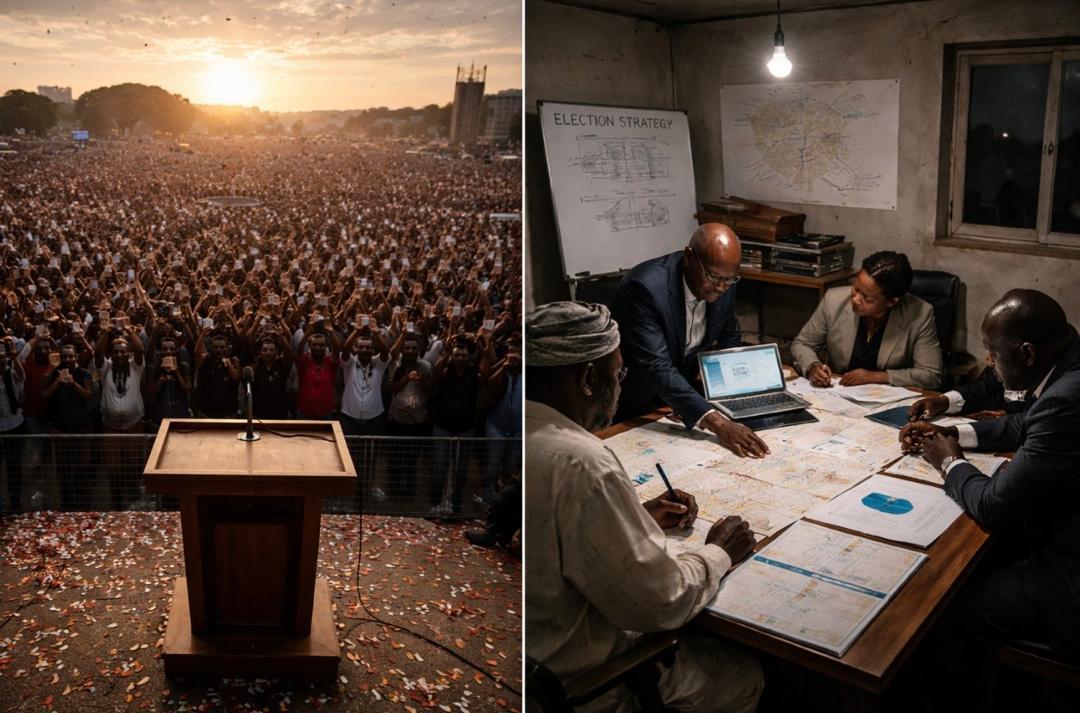
As Nigeria gears up to go to the ballot next year, in January and February, the outrage that has become a defining feature of the primary elections so far conducted nationwide in the ruling party leaves a trail of more controversy, and this suggests that Nigerian democracy is still struggling to redeem itself. In the coming days, other political parties will also round up their primary exercises. Notably, the All Progressives Grand Alliance (APGA), which is popular in Anambra State, will have its own direct primary exercise for elective positions on Saturday. Meanwhile, the African Democratic Congress (ADC) and Nigeria Democratic Congress (NDC), which are emerging opposition political parties in Nigeria, will hold theirs in the coming week. What is on trial is the challenge of producing acceptable candidates who reflect the free mandate of all party faithful, so that they represent the party and compete with other political parties in the general election next year. There are already accusations of exploitation in the NDC. In the ADC, there is an allegation of the imposition of a candidate.
So long as politicians find a way to negotiate democracy in political parties, more serious matters of good governance and corollaries would remain deferred to a later time.